India produces enormous quantities of food. The bigger economic question is what happens to it after harvest.
Over the past decade, the country has been pushing to process, package and export more of its agricultural output rather than selling it primarily as raw produce. Government figures show that processed foods accounted for 20.4% of India’s agricultural exports in 2024-25, up from 13.7% a decade earlier. The gross value added by the food processing industry has also risen from ₹1.34 lakh crore in 2014-15 to ₹2.24 lakh crore in 2023-24.
That shift provides the backdrop for Indusfood Manufacturing 2027, which returns to New Delhi from January 6 to 8 with machinery, packaging systems and factory technology aimed at food and beverage producers.
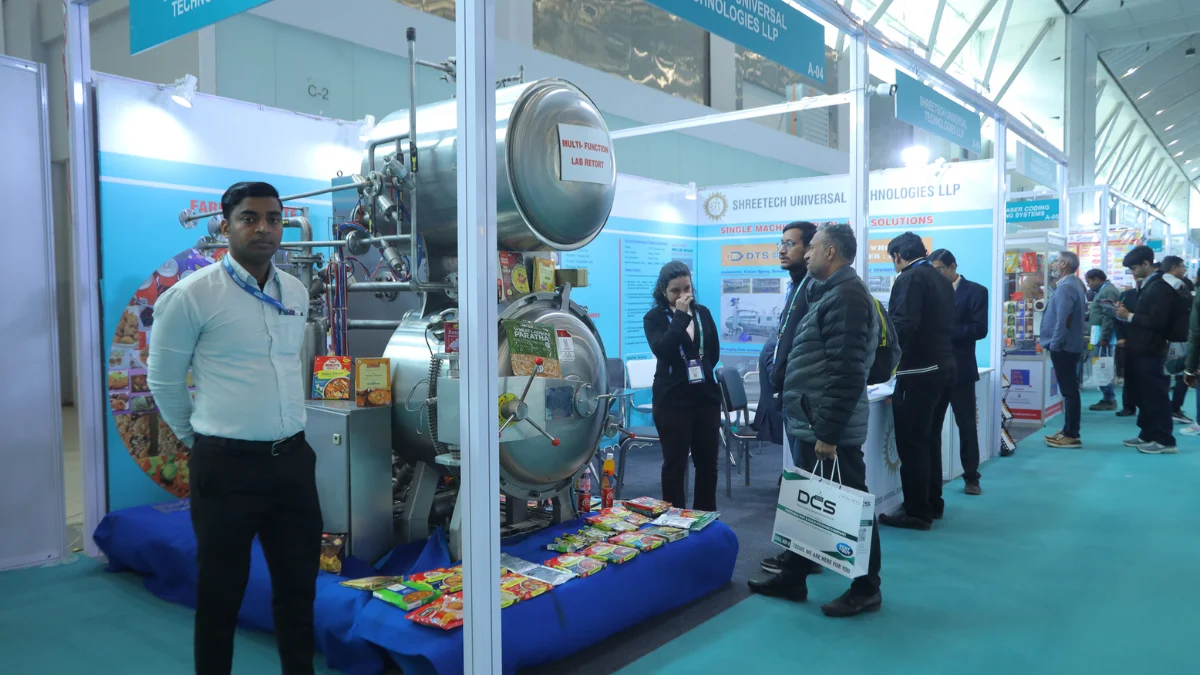
The exhibition is less about what ends up on supermarket shelves than about the equipment required to get it there.
Processing lines, beverage systems, packaging machinery, smart factory technology and ancillary equipment are spread across 15 manufacturing zones. Organizers are also planning more than 200 live machinery demonstrations, allowing manufacturers to see production systems operating rather than simply examining equipment on stands.
More value from the same agricultural base
India’s food processing strategy is closely tied to the scale of its agricultural economy.
The government argues that greater processing capacity can help reduce post-harvest losses, create manufacturing jobs and allow producers to sell higher-value goods into domestic and international markets. Food processing already accounts for nearly 13% of employment in India’s registered manufacturing sector.
Recent industrial policy has tried to accelerate that transition.
India’s Production Linked Incentive scheme for food processing had generated 34 lakh metric tonnes of annual processing capacity by June 2026, according to government data. Sales of products supported by the program rose from ₹58,758 crore in 2019-20 to ₹1.09 lakh crore in 2025-26.
Those numbers point to a broader change in how India sees its food economy. Growing crops remains fundamental, but competitiveness increasingly depends on what happens next: preservation, processing, packaging, storage and distribution.
The factory becomes part of the export story
Indusfood Manufacturing reflects that shift.
The event brings processing technology together with packaging, automation, ingredients and digital production systems. Its conference program also covers manufacturing efficiency, compliance, sustainability and export readiness, subjects that become more important as Indian producers try to compete beyond the domestic market.
Packaging is especially important in that equation. Longer shelf life, consistent quality and compliance with destination-market requirements can determine whether a food product is suitable for international distribution at all.
Automation adds another layer. Scaling production for larger markets requires manufacturers to produce more consistently while controlling waste, labor requirements and operating costs.
The 2027 show is therefore arriving at a point when food manufacturing is becoming a larger part of India’s agricultural growth story.
The country does not lack raw material. The challenge is turning more of that agricultural output into finished products that can travel farther, last longer and command greater value.
Indusfood Manufacturing 2027 will take place from January 6 to 8 at Yashobhoomi, India International Convention and Expo Centre in New Delhi.